This is an old revision of the document!
La Doña Juana Landfill is the main municipal solid-waste landfill for Bogota, and receives waste from the city and nearby municipalities(Pedro E,2020). The landfill which had been operating at an overloaded capacity for many years, experienced severe landside accidents in 1997, 2015 and 2020.
The main issue surrounding this landfill site is that the unstable technology for waste disposal has led to environmental pollution around it and damage to the health of residents( Lanzas,2017). This has triggered a community conflict regarding whether the current waste disposal model should be changed, replacing the traditional method of burying waste with a more environmentally friendly approach that can potentially recycle the waste, and closing the landfill site(Paola,2024).
Geologically, the area consists of a basin of sedimentary rocks, primarily claystone and limestone from the Bogotá Formation, as well as Quaternary deposits. According to *Lozano and Ávila (2024), the Doña Juana major solid waste (MSW) landfill covers an area of 500 hectares, with waste heights varying from 30 to 120 meters. The capacity of the waste in the La Doña Juana Landfill has led to overflowing waste, which has reached the Tunjuelo River in the southeast area. Referring to Figure 1, the affected area of the landslide expanded from the northeast to the south between 2015 and 2020. The first and largest flow-type landslide occurred on September 27, 1997, in Bogotá, resulting overflowing waste and materials clogging the Tunjuelo River. Therefore, the Quebrada Limas River in the northwest area of Bogotá has been polluted due to its intersection with the Tunjuelo River.
Fig 1: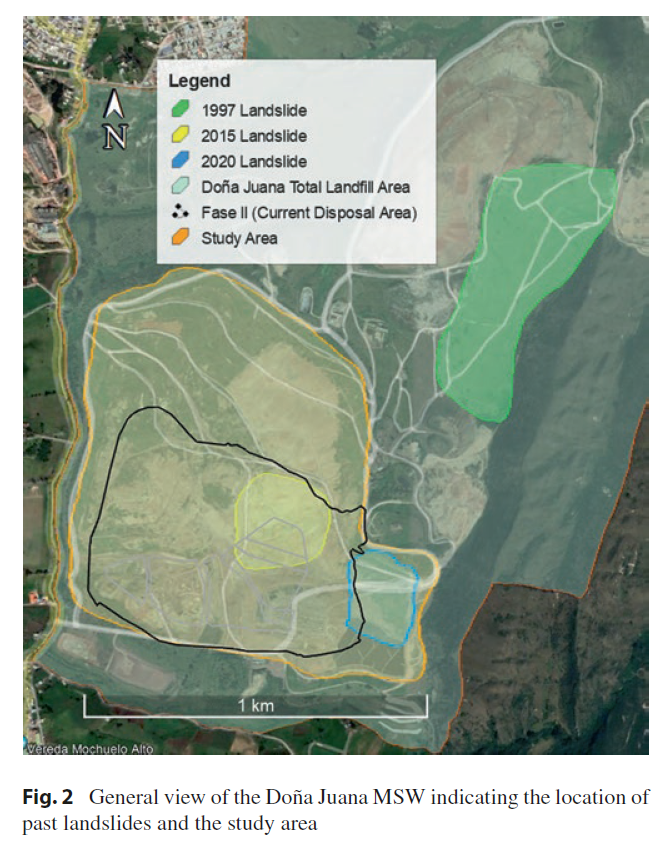
Meanwhile, Lucci (2025)’s performance in Museo Libre provided potential for the future transformation of La Doña Juana Landfill. He utilized 【tires as the medium】 for artistic expression. These tyres originally waste along the Tunjuelo river and the quebrada_limas_river. Usually, these wastes would form a small landfill along the riverbank, where locals would burn the waste, generating toxic gases. The weather system causes the toxic gas to enter the clouds through the water vapor in the air, and the cloud spreads everywhere and form rainfall. As a result, pollutants were spread throughout various regions and the soil. It also caused soil pollution. The remaining waste was then dumped into the river. The emergence of Museo Libre was a public education initiative, offering locals a possibility for waste utilization in a way that resisted the unreasonable utilization of landfill. It also drew attention to the health conditions of the rivers and the people living along them.River pollution is the result of multiple factors. This outcome further affected the surrounding environment and locals, causing the death of livestock and illness. (Lucci, 2025).
Reference List Biljana, A, ed. (2024) Progress in Landslide Research and Technology, Volume 3 Issue 1